
The moment someone is arrested, one question tends to overshadow everything else: How do we get bail?
It sounds simple. In practice, it rarely is.
The process in a Magistrate Court follows a fairly structured path, yet the outcome often turns on small details—timing, paperwork, even how the facts are framed. What follows is not just a list of steps, but a closer look at how the process usually unfolds in Bangladesh.
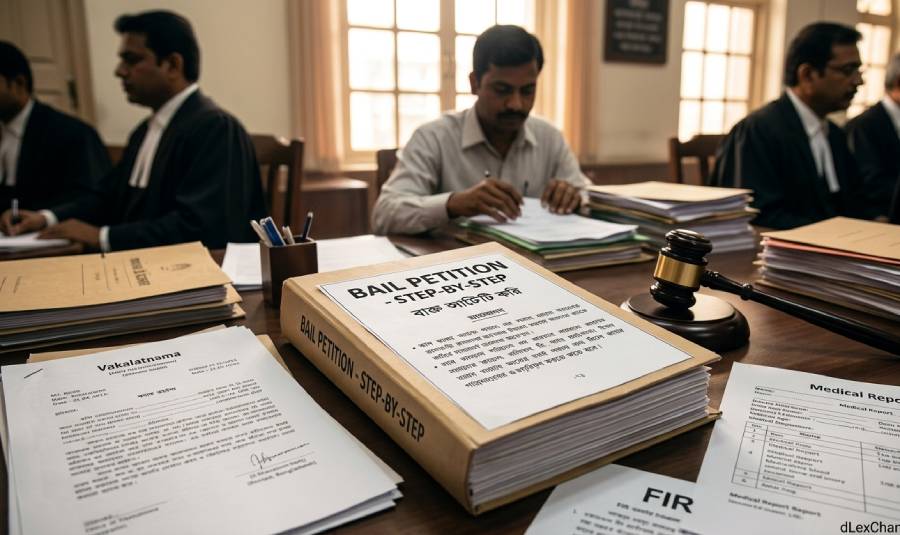
Before anything is filed, a basic question needs answering: Is the offence bailable or non-bailable?
That distinction shapes everything that comes next. In bailable offences, the law allows bail almost as a matter of right, subject to conditions. Non-bailable offences, however, place discretion squarely in the hands of the Magistrate.
Clients often assume that “non-bailable” means “no bail.” That’s not quite accurate. It simply means bail is not automatic. The court weighs factors—sometimes unpredictably.
The bail petition is not a formality. It is, in many ways, the first real argument placed before the court.
A typical petition includes:
On paper, this seems straightforward. Yet the difference between a routine petition and a persuasive one often lies in how those grounds are framed. A vague claim rarely helps. Specificity—anchored in the case record—tends to carry more weight.
Once prepared, the petition is filed in the appropriate Magistrate Court where the case is pending.
Timing matters here. In many instances, the accused is produced before the court within 24 hours of arrest. That first production becomes the earliest opportunity to seek bail.
Delays can happen. Court schedules are not always predictable.
This is where the process becomes more dynamic.
The defence lawyer presents arguments in favour of bail. The prosecution—often through the Assistant Public Prosecutor—may oppose it, particularly in non-bailable cases.
What does the court consider?
Not a fixed checklist, but certain patterns appear:
None of these factors operate in isolation. A relatively minor offence, if paired with a history of non-compliance, might still face resistance. Conversely, a serious allegation with weak evidence may tilt toward bail.
After hearing both sides, the Magistrate may:
Conditional bail is common. Conditions may include:
At times, the reasoning is delivered briefly. Detailed orders are less common at this stage, though they may appear in more contested matters.
If bail is granted, the process is not quite over.
The accused must execute a bail bond, usually supported by one or more sureties. The court verifies these details before issuing a release order.
Only then does the actual release take place.
In practice, this final step—paperwork, verification, communication with jail authorities—can take longer than expected. Families often find this part surprisingly slow.
Rejection at the Magistrate level is not the end of the road.
The accused may move to a higher court—typically the Sessions Court—for bail. In some cases, approaching the High Court Division becomes necessary.
Each level introduces a different standard of scrutiny. It’s not merely a repetition of the earlier application.
From experience, the bail process is as much about preparation as it is about law.
Incomplete documents, rushed petitions, or poorly framed arguments can weaken an otherwise reasonable case. On the other hand, even a difficult case may benefit from careful presentation.
There is also a quieter reality: outcomes can vary from court to court. Not drastically, but enough to matter.
1. How long does it take to get bail in Magistrate Court?
It can happen on the same day of production, though delays of a few days are not unusual.
2. Is a lawyer mandatory for bail?
Technically, a person may apply without one. Practically, legal representation makes a noticeable difference.
3. Can bail be cancelled after being granted?
Yes. If conditions are violated or new facts emerge, the court may cancel bail.
4. What happens if surety cannot be arranged immediately?
Release may be delayed until proper surety is provided.
The bail process, at least on paper, appears orderly. File the petition. Argue the case. Wait for the order.
Reality is less tidy.
Small procedural gaps, courtroom dynamics, and timing all seem to play a role. Understanding the structure helps, but navigating it effectively often requires a more careful approach—one that anticipates both legal and practical hurdles.