
If you’ve ever visited a criminal court in Bangladesh—or even spoken with someone involved in a case—you’ve probably heard the terms GR case and CR case used almost interchangeably. That’s where confusion begins. They sound similar. They’re not.
The distinction, while procedural, can shape how a case begins, who controls it, and how quickly it moves. For a client, it often determines the very first step toward justice.
Let’s unpack this carefully.
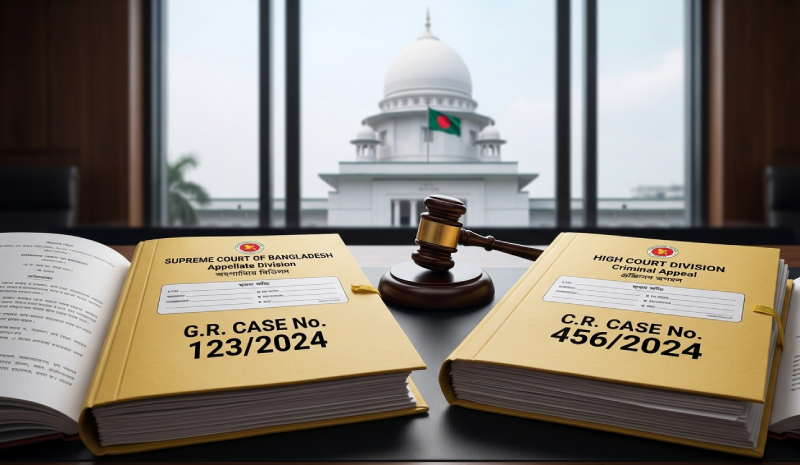
A General Register (GR) case begins with the police. More specifically, it starts when an FIR (First Information Report) is lodged at a থানার (police station). Once recorded, the matter enters the formal criminal justice system under police supervision.
From there, the process follows a familiar route—investigation, collection of evidence, witness statements, and eventually a charge sheet (or sometimes a final report, if evidence is lacking).
In practice, this means the state takes the lead.
You, as a complainant, step slightly into the background. The police investigate. The prosecution proceeds on behalf of the state. This can be efficient, but it also means you don’t fully control the pace or direction of the case.
It’s commonly used in offences like:
A Complaint Register (CR) case, by contrast, begins not at the থানার but directly in court. The complainant approaches a Magistrate and files a petition describing the alleged offence.
No FIR. No immediate police involvement—at least not initially.
Instead, the Magistrate examines the complaint. Sometimes witnesses are heard at the outset. If the court finds sufficient grounds, it may issue process (summons or warrant). In some situations, the matter is later referred to police for investigation under Section 202 of the Criminal Procedure Code.
This route places greater control in the hands of the complainant.
It is often preferred where:
The contrast becomes clearer when placed side by side:
| Aspect | GR Case | CR Case |
|---|---|---|
| Starting Point | Police Station (FIR) | Directly in Court |
| Who Initiates | Police (after complaint) | Private complainant |
| Investigation | Police-led | Court-led (may involve police later) |
| Control | State-driven | Complainant-driven |
| Speed | Can be faster initially | Sometimes slower at the start |
| Suitable For | Serious offences | Situations where FIR is not registered |
Still, the table only tells part of the story. In real litigation, these categories occasionally overlap. A CR case may evolve into something resembling a police case if the court directs investigation. Likewise, dissatisfaction with a GR case investigation can push a complainant toward alternative remedies.
There isn’t a universal answer. It depends—on facts, on urgency, and sometimes on practical realities.
If the offence is serious and immediate police action is necessary, a GR case is usually the natural route. The system is designed for it.
But situations arise where the police hesitate, delay, or simply refuse to register a case. That’s when a CR case becomes not just an alternative, but a necessary one.
From experience, many clients assume filing an FIR is the only option. It isn’t. The law provides parallel paths, though navigating them requires careful judgment.
It may be tempting to treat GR and CR cases as technical labels. In reality, they reflect two different entry points into the criminal justice system—one administrative, the other judicial.
That difference matters.
It affects strategy. It shapes expectations. And, in some instances, it may influence the outcome itself.
1. Can a CR case become a GR case?
Not exactly, though a Magistrate can direct police investigation, which may resemble a GR-type process.
2. Which is faster—GR or CR?
A GR case often starts faster because police act immediately. A CR case may take time at the initial stage but offers more direct court involvement.
3. Can police refuse to file an FIR?
Yes, it happens. In such cases, filing a CR case is a lawful remedy.
4. Do I need a lawyer for both?
Practically speaking, yes. Even if not legally mandatory at every stage, proper legal guidance makes a significant difference.
The difference between GR and CR cases is not merely procedural—it’s strategic. One begins with the state stepping in. The other begins with you.
Choosing the right path requires more than a surface-level understanding. It calls for a reading of the facts, the risks, and sometimes the unspoken realities of how cases move through courts in Bangladesh.
If you are unsure whether to file a GR case or CR case, our team at dLex Chamber can guide you based on your situation.
👉 Call now for consultation
👉 WhatsApp for quick legal advice
👉 Visit our chamber in Dhaka